
下北阳光灿烂的日子
Ecuadorians electing new president, choosing between an heir to a banana empire and an attorney_我的网站

A |
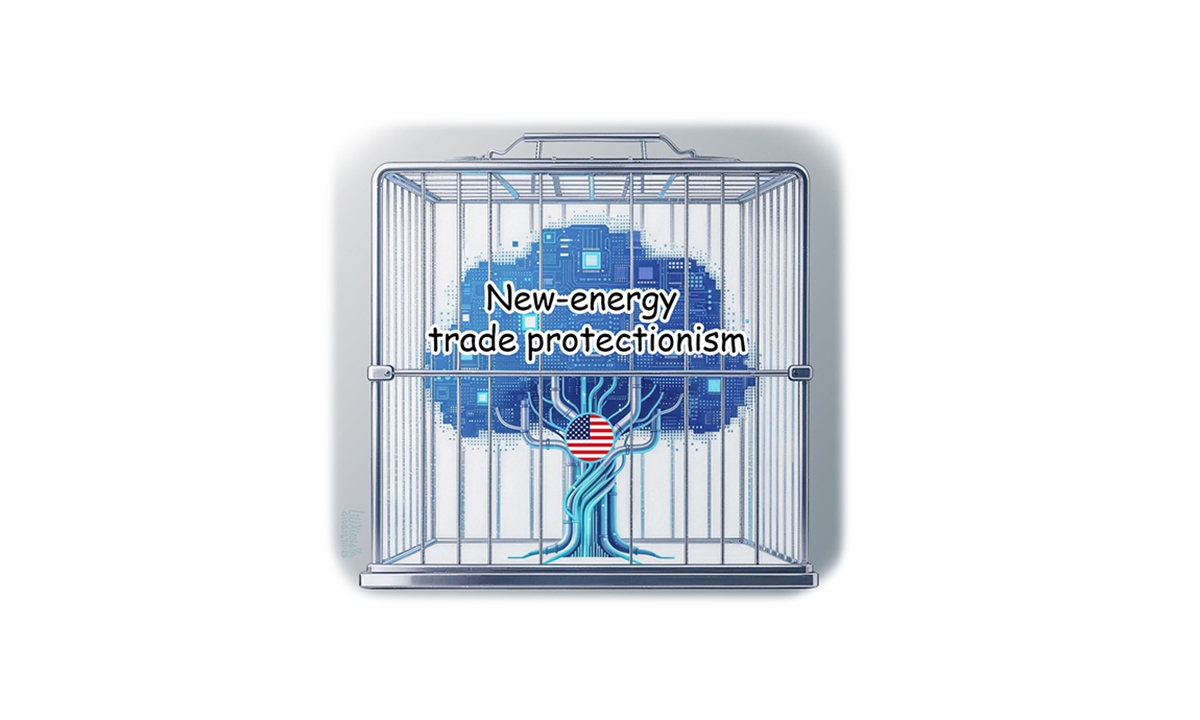
Recent media reports have questioned whether a natural gas plant built to power an Amazon data center project in Texas could become the largest climate polluter in the US. The controversy, whatever the eventual outcome, offers a reality check for America's artificial intelligence (AI) drive.
It exposes a growing contradiction: The US is racing to expand its AI capabilities, yet its protectionist trade policies are making it harder and more costly to access some of the clean-energy technologies needed to sustain that expansion. This raises a broader question: Can an energy-intensive AI race afford the costs of renewable energy protectionism?
The US is entering a new era of rising electricity demand. Data centers, the backbone of the AI economy, are emerging as one of the fastest-growing sources of power consumption. Much of that demand is still being met by fossil fuels: The International Energy Agency reports that natural gas supplies more than 40 percent of the electricity used by data centers in the US, making it their largest source of power.
So, it's not surprising that the expansion of data centers has raised concerns over their environmental impact and the pressure they could place on local power systems and electricity bills. A Gallup survey conducted in March found that seven in 10 Americans opposed the construction of AI data centers in their local area, including 48 percent who strongly opposed such projects.
The findings point to a broader challenge for the US: The race to develop AI is increasingly becoming a race to meet growing energy needs. Addressing this challenge will require more than advances in computing technology; it will also depend on an energy system capable of delivering large amounts of reliable, affordable and cleaner power. That, in turn, will require faster development and broader deployment of clean-energy technologies, from solar power to energy storage.
Yet in the clean-energy sector, the US has increasingly relied on protectionist trade measures that limit access to cost-competitive products from global markets. The country has placed greater emphasis on expanding domestic manufacturing capacity, but rebuilding entire clean-energy supply chains at home is a costly and time-consuming process. Even if expanded domestic production is achieved, it is likely to come at a higher cost, making the deployment of renewable technologies more expensive and potentially slower.
The solar industry offers a clear illustration of this policy direction. The US has continued to expand trade barriers in the sector. Reuters reported that the US government announced on Thursday a series of price floors and a 15 percent tariff on products made from polysilicon, a raw material used in solar panels.
The challenge lies in the limited scale of the US polysilicon industry. Reuters reported that the country has two polysilicon factories. Against this backdrop, relying on domestic polysilicon production while restricting access to imports runs counter to the goal of expanding solar power in the US. The country risks creating barriers that ultimately constrain its own access to the global supply chains needed for growth.
The pressing issue for the US is the speed at which new power demand is emerging. The expansion of data centers is creating electricity needs that cannot wait for domestic clean-energy capacity to develop gradually. Global supply chains can provide the scale and speed required in the near term. By narrowing access to these sources, the US risks turning clean-energy policy into a drag on the infrastructure needed for its AI race.
The US has placed AI high on its economic and technological agenda. The outcome of this race will matter greatly, as financial markets are also watching whether America can turn its AI efforts into commercial success.
This leaves the US with a difficult choice: Can it afford the cost of clean-energy protectionism while racing to build AI infrastructure? The answer may be no. Trade barriers that limit access to competitive renewable technologies could ultimately become a constraint on the AI expansion that Washington is seeking to accelerate.
The author is a reporter with the Global Times. [email protected]
。 CARACAS, Venezuela -- Frightened by unprecedented violence on the streets and within prisons, Ecuadorians have a universal demand for the president they will choose Sunday — safety.The runoff election in the South American country pits an heir to a banana empire, Daniel Noboa, and an attorney, Luisa González. Both have limited governing experience and will undoubtedly have their work cut out.The election comes as more Ecuadorians become victims of drug-related violence that erupted roughly three years ago and intensified in August, when a presidential candidate was assassinated in broad daylight. People continuously watch their backs and limit how often they leave home. The uneasiness even pushed Noboa to add a bulletproof vest to his daily outfit.Whoever wins with a simple majority of votes will govern for only 15 months, until May 2025, which is what remains of the presidency of Guillermo Lasso. He cut his term short when he dissolved the country’s National Assembly in May as lawmakers carried out impeachment proceedings against him over alleged improprieties in a contract by a state-owned company.Lasso, a conservative former banker, clashed constantly with lawmakers after his election in 2021 and decided not to run in the special election. Under Lasso's watch, violent deaths soared, reaching 4,600 in 2022, the country’s highest in history and double the total in 2021. The National Police tallied 3,568 violent deaths in the first half of 2023.“Security affects us all, and whether poor or rich, no one is safe from criminals anymore,” housewife Ximena Flores said ahead of the runoff election. “Do you think that a new president will be able to do something in such a short time? I think not. It will be a new disappointment for everyone.”The spike in violence is tied to cocaine trafficking. Mexican, Colombian and Balkan cartels have set roots in Ecuador and operate with assistance from local criminal gangs.Voting is mandatory in Ecuador for people ages 18 through 64. Those who don’t comply face a fine of about $45. Polls were to close in late afternoon, and results were expected Sunday evening.Noboa and González, both of whom have served short stints as lawmakers, advanced to the runoff by finishing ahead of six other candidates in the election’s first round Aug. 22.Noboa, 35, is an heir to a fortune built on Ecuador’s main crop, bananas. His political career began in 2021, when he won a seat in the National Assembly and chaired its Economic Development Commission. He opened an event organizing company when he was 18 and then joined his father’s Noboa Corp., where he held management positions in the shipping, logistics and commercial areas.González, 45, held various government jobs during the decade-long presidency of Rafael Correa, her mentor, and was a lawmaker until May. She was unknown to most voters until Correa’s party picked her as its presidential candidate. At the start of the campaign, she said Correa would be her adviser, but she has recently tried to distance herself a bit in an effort to court voters who oppose the former president.___Associated Press writer Gonzalo Solano in Quito, Ecuador, contributed to this report.。
Current article:http://www.minshixuanhabing.bond/qxak/9uid.html
Published on:09:45:01
相关新闻
- Suspected Gunman in Illinois July 4 Parade Shooting Confessed to Police, Considered Second Attack
- 支付宝宣布全球用户超过10亿
- 汽车市场的突破点在哪里,卷价格是否是唯一出路?
- IGN盛赞国产《湮灭之潮》:高速战斗很爽 还想再玩
- 今年最强!“梅花”登陆!
- 全国粮食品牌建设工作推进会在吉林召开
- Death toll from coal mine blast in Turkey rises to 28
- 马德兴:真正的青训需要很多年,互联网最擅长制造一个下午的天才
- 商业零售概念震荡反弹,上海九百直线涨停
- 明基推出 ScreenBar Max 双屏全景灯:为双显示器场景设计、全景非对称光型,1999 元
最后更新
- 各扫门前雪 清雪保畅齐动员
- Seven Tonnes of Radioactive Water Reportedly Leaked at 3rd Reactor of Japan's Mihama NPP
- 【卫生保健】关爱健康,预防流感–华南师范大学幼教实验基地.广州市天河区天云幼儿园流感预防知识宣传
- 上下纵横,澳门前行——澳门特区行政长官岑浩辉解读“三五”规划
- Stranger Things Season 5 Volume 1 Trailer Explained: Eleven’s Return, Demogorgons & Steve’s Big Move
- 可隆发布中国国家攀岩队新赛季战袍「炽翎」以专业实力护航“向上”征程
- 20个关键词,串起梁文锋四小时分享
- 订单排到2027年!中国“降温节水”神器在欧洲热卖
- 专栏作者质疑哈登续约:37岁老将合同恐成隐患
- NBL杭州经纬官宣6名国内球员加盟!包括胡布郎/马泳等多位CBA球员