蜜月计划
Apple reportedly tests CXMT chips, showing China-US industrial chain cooperation ‘irreversible’: experts_我的网站

A |
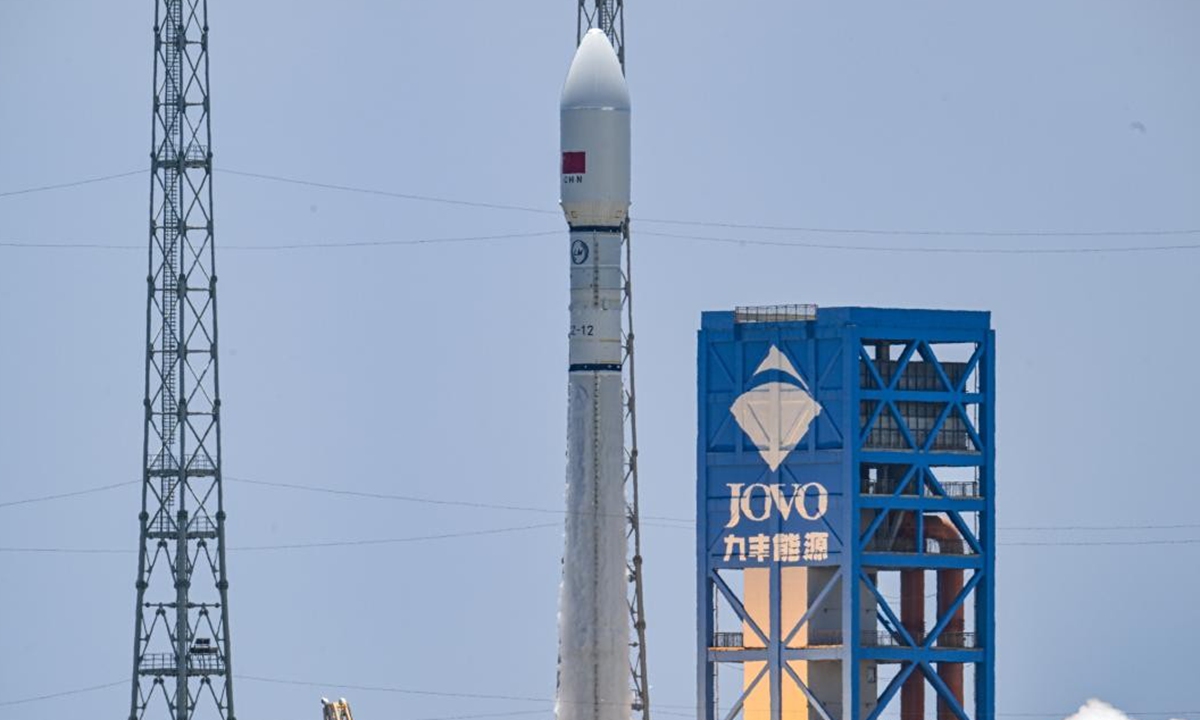
The 24th group of the low-orbit internet satellites aboard a Long March-12 carrier rocket is launched at 12:10 pm on August 16, 2026 from a commercial spacecraft launch site in the southern island province of Hainan. Photo: VCG
Two successful launches among China's recent frequent moves caught particular attention of space watchers - the 24th group of low-Earth orbit internet (LEO) satellites aboard a Long March-12 rocket was sent from a commercial spacecraft launch site in the southern island province of Hainan on Sunday, 12 days after the 23rd group of LEO satellites aboard a Long March-8A rocket was launched from the same Hainan site on August 4.
Sunday's mission marked the 663rd launch of the Long March series of carrier rockets, which on Monday sent an SEO satellite into preset orbit, per Xinhua.
Experts said the launches of two groups of LEO satellites within 12 days underlined that China is notably accelerating its pace of building its satellite internet constellation.
"The launch of LEO satellites has now entered a regular and cyclical rhythm, with batches of satellites continuously being sent into orbit at relatively stable intervals," Kang Guohua, a senior member of the Chinese Society of Astronautics and a professor of Aerospace Engineering at Nanjing University of Aeronautics and Astronautics, told the Global Times on Monday.
China launched the first group of LEO internet satellites on December 16, 2024, proceeding to the 24th batch in about 20 months. Kang said three major production and launch "assembly lines" are supporting the effort: satellite factories featuring centralized design in Beijing, coordinated supply chains and mass production; rockets with streamlined launch and testing procedures and multiple configurations; and launch sites capable of supporting routine constellation deployment.
The Long March-12, which played a key role in the latest LEO satellite launch, is China's first 4-meter-class single-core-stage carrier rocket and was specifically developed for commercial launch needs. It is about 62.6 meters long, has a liftoff mass of 430 tons and can carry more than 12 tons to low-Earth orbit. Its first stage is equipped with four 1,250-kilonewton pump-fed liquid oxygen-kerosene engines and uses a newly developed coal-based aerospace kerosene, according to Shanghai Academy of Spaceflight Technology.
The rocket adopts a "three-horizontal" launch preparation model: horizontal assembly, horizontal testing and horizontal transportation. Depending on mission requirements, it can use fairings with diameters of 4.2 or 5.2 meters and support both single-satellite and multi-satellite launches into different orbits.
"This flexibility makes the Long March-12 particularly suitable for the 'one rocket, multiple satellites' model required for constellation deployment, making it one of the main launch vehicles currently used for LEO constellation missions," Kang said.
The mission also highlighted the launch site's growing ability to support high-frequency launches. The rocket took only two and a half days from being transported to the launch area to liftoff, setting a record for the shortest time a rocket occupied the launch position at the site, Kang said.
Despite the rapid progress, experts cautioned that the 228 satellites currently in orbit remain some distance from the ultimate goal. China's satellite internet project has a long-term goal of deploying nearly 8,000 satellites and is now in an accelerated "weaving" phase.
China's advantage lies in its ability to control costs and boost production efficiency once satellite manufacturing reaches mass-production scale, another expert surnamed Liu told the Global Times.
"Whether it is the production capacity of AI centers or the factory in Hainan, which has an annual satellite manufacturing capacity of 1,000 units, satellite production itself is not the problem," Liu said. "More bottlenecks lie in the operational efficiency of launch pads and the rocket payload and recovery technology."
The real challenge lies in rocket reusability. Only by lowering launch costs and increasing launch frequency can China sustain a pace of more than one launch per week. This is also the strategic significance of accelerating the development of reusable rocket technology, including the Long March-10B and privately developed rockets, Kang further noted.
Chinese Academy of Engineering academician Deng Zhongliang previously said in an interview that satellite internet will serve as an indispensable space-time infrastructure for 6G, enabling emerging industries worth trillions of yuan, including the low-altitude economy, advanced autonomous driving and the Internet of Things (IoT).
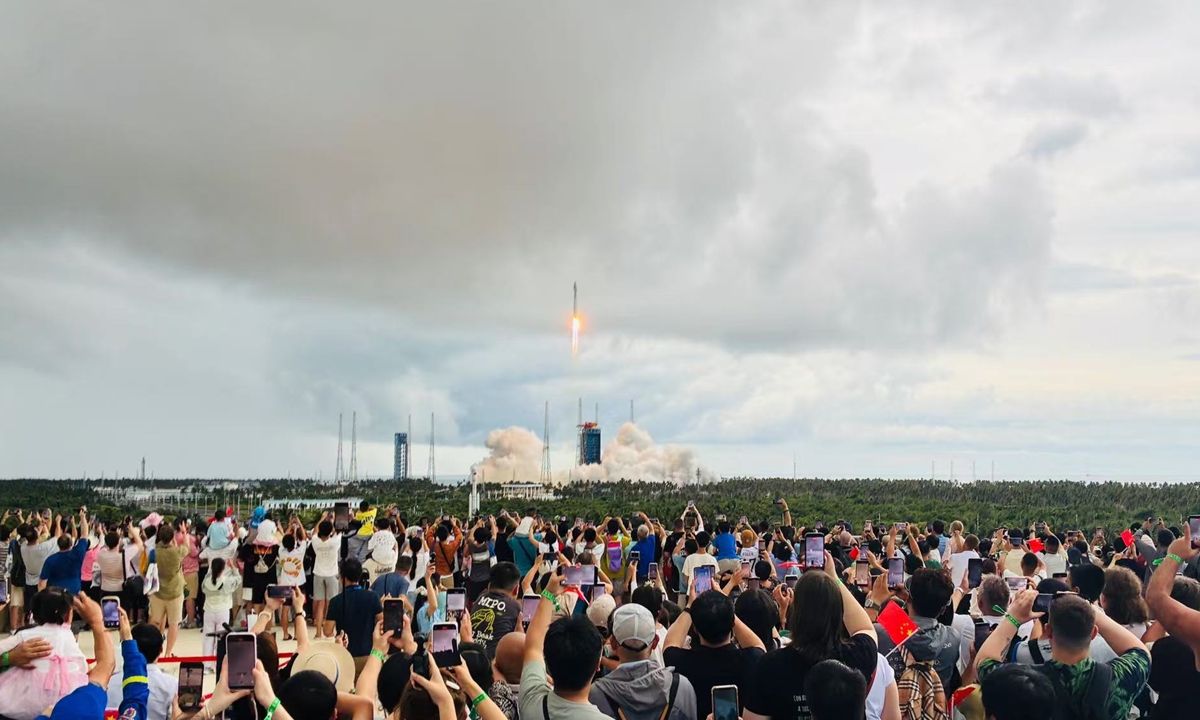
The 23rd group of low-orbit internet satellites aboard a Long March-8A carrier rocket is launched on August 4, 2026 from a commercial spacecraft launch site in the southern island province of Hainan. Photo: VCG
。

B |
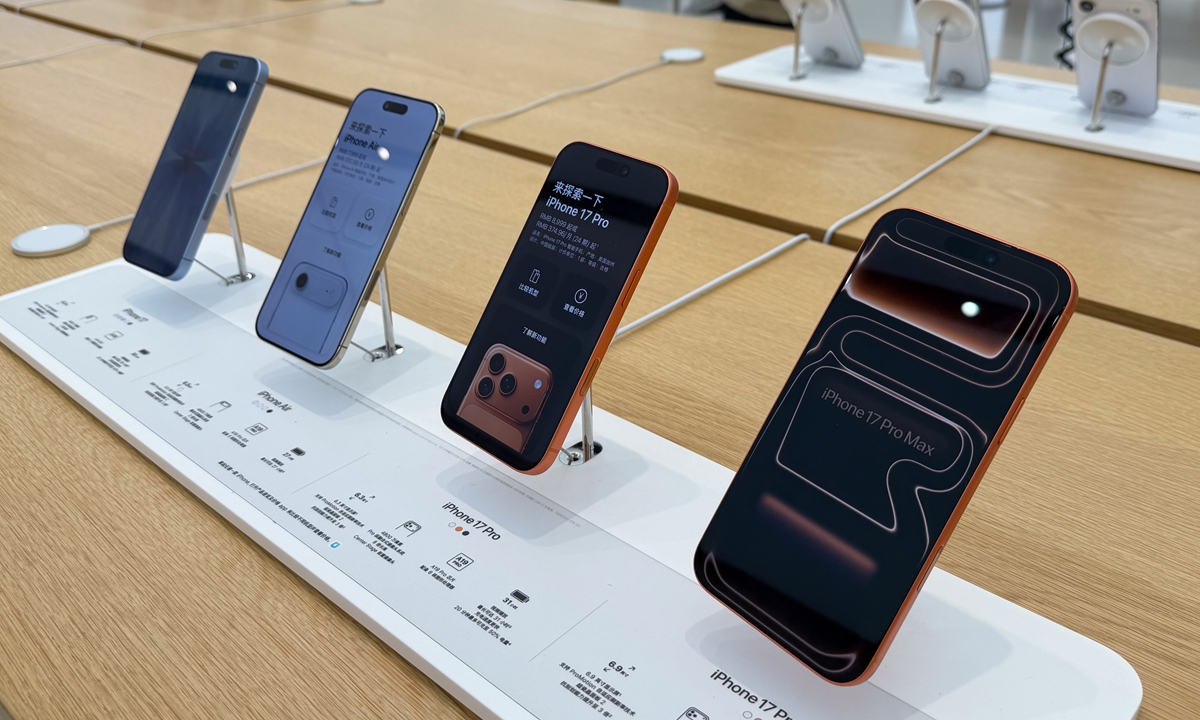
View of iPhones at a store in Shanghai on August 5, 2026 Photo: VCG
After media reports saying that US tech firm Apple has been testing memory chips from Chinese chipmaker ChangXin Memory Technologies (CXMT) across product lines including iPhones and MacBooks, Chinese experts said on Monday that Apple may seek to adopt memory chips from CXMT to control rising costs for its electronic devices despite obstruction by some US politicians.
If the report is true, the move would not only underscore the technological leap and rising global competitiveness of China's semiconductor sector, but also demonstrate that deeper supply‑chain integration among multinationals is an irreversible trend, experts noted.
Apple has held early talks with CXMT about supplying components with the goal of using them in some devices sold in China, The Wall Street Journal reported on Sunday, citing people familiar with the matter. "Apple hopes to win the White House's blessing to do business with the Chinese company," the report stated.
Laptop makers HP and Acer have begun using memory chips from CXMT in devices sold outside the US to alleviate ongoing memory supply strain, people familiar with the matter said, according to the report.
Both companies didn't reply when reached by the Global Times on Monday for comment.
"Amid a sizable global memory supply crunch, Apple is forced to widen its supplier base to contain rising costs. Thus, despite heavy US political pressure, it is highly likely to adopt CXMT chips," Ma Jihua, a veteran technology industry analyst, told the Global Times on Monday.
In June, Apple raised iPad and MacBook prices, saying it could no longer shield customers from soaring memory and storage chip costs driven by the AI industry's datacenter buildout, Reuters reported.
Against this backdrop, CXMT has emerged as a potential counterweight to these cost pressures. The company's shares closed up 465.82 percent on its July 27 market debut, giving it a market capitalization of over 3.2 trillion yuan ($471.2 billion), becoming one of the world's largest producers of dynamic random-access memory (DRAM) and the most valuable listed company on the A-share market.
"Represented by CXMT, a batch of Chinese hard-tech firms constantly focus on innovations in recent years. Their product performance and supply capacity are steadily approaching international advanced levels, attracting an increasing number of market-driven multinationals to actively embed themselves in China's supply chains," Bao Jianyun, dean and professor of the Department of International Politics at the School of International Studies at Renmin University of China, told the Global Times on Monday.
China's exports of integrated circuits (ICs) reached $216.02 billion in the first seven months of 2026, up 99.5 percent year-on-year, according to data released by the General Administration of Customs (GAC) on Friday.
Prompted by the rapid development of integrated circuit technologies and the need to better meet market demands, China recently issued revised regulations on the protection of IC layout-designs. Scheduled to take effect on October 15 this year, the regulation aims to strengthen the protection and application of layout-designs and improve registration and management systems by elevating proven practices into regulations, while also aligning with relevant laws and international treaties.
These institutional upgrades, paired with policies to boost domestic demand and improve market access, are reinforcing China's appeal as a stable anchor for global semiconductor investment.
Samsung Electronics and SK Hynix are evaluating chipmaking equipment from China's Advanced Micro-Fabrication Equipment for possible use at their Chinese factories, three people familiar with the matter said, as the South Korean firms hedge against the risk of tighter US export controls, Reuters reported on August 5.
"If these reports are true, the trend once again shows that it's an irreversible historical tide for multinationals to expand cooperation with Chinese firms according to market principles. The US side's political attempt to build 'small yard, high fence' and push 'decoupling' is doomed," Bao said.
The rise of Chinese-made memory chips and recent tech innovations - including Unitree Robotics' humanoid robots and Moonshot's Kimi K3 - underscore that unilateral US sanctions cannot prevent Chinese technological iteration, nor can protectionism block open cooperation, the expert said.
。
Current article:http://www.minshixuanhabing.bond/nhx6q/20260826/4778864.docx
Published on:05:39:29


 发表于 10:07:42
 QQ好友和群
 QQ空间
QQ空间 腾讯微博
腾讯微博 腾讯朋友
腾讯朋友 收藏
收藏 支持
支持 反对
反对
 发表于 06:27:37


