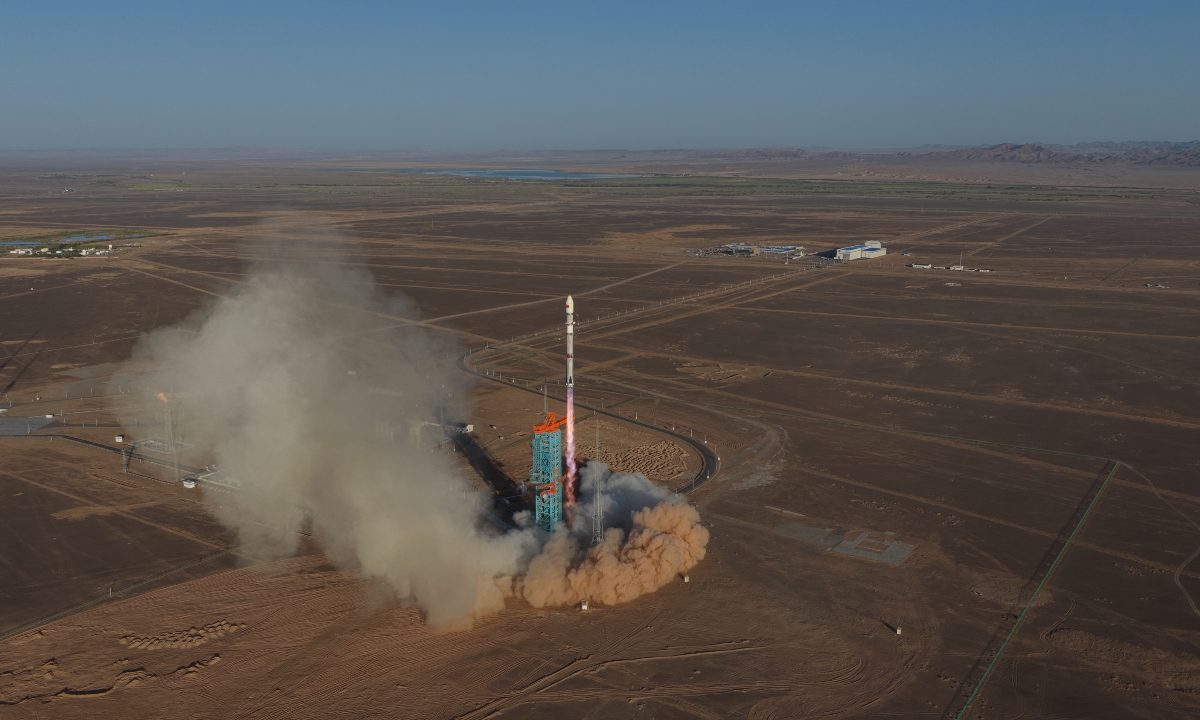
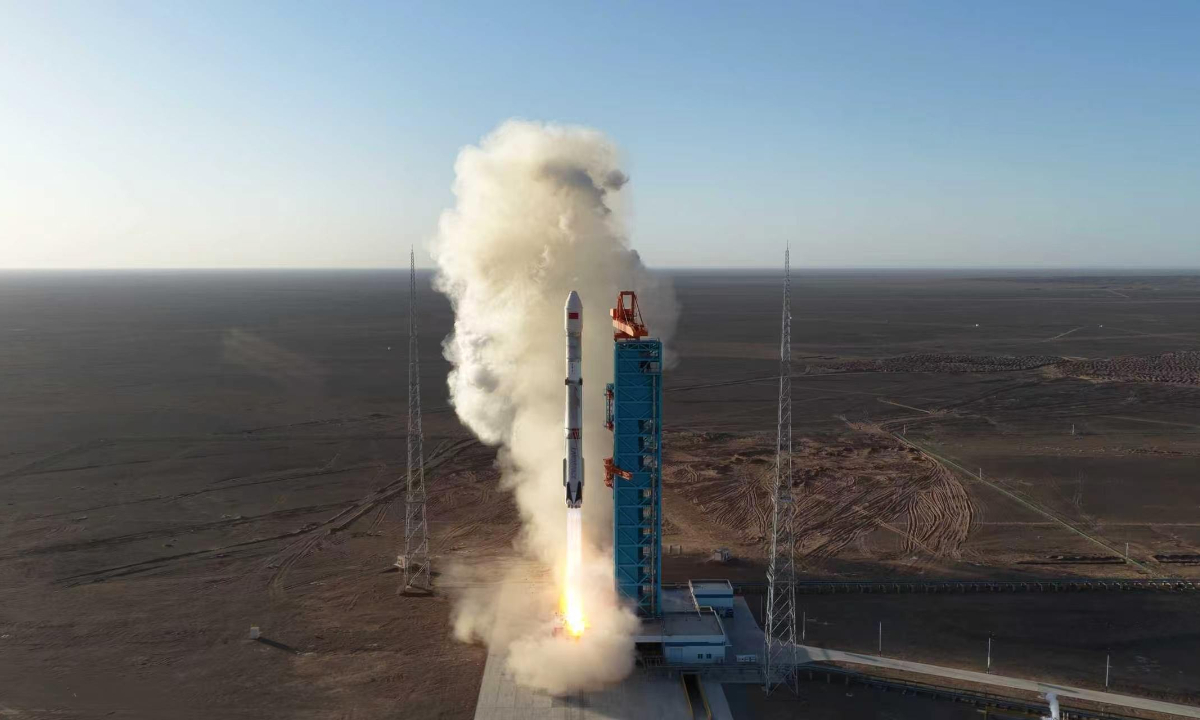
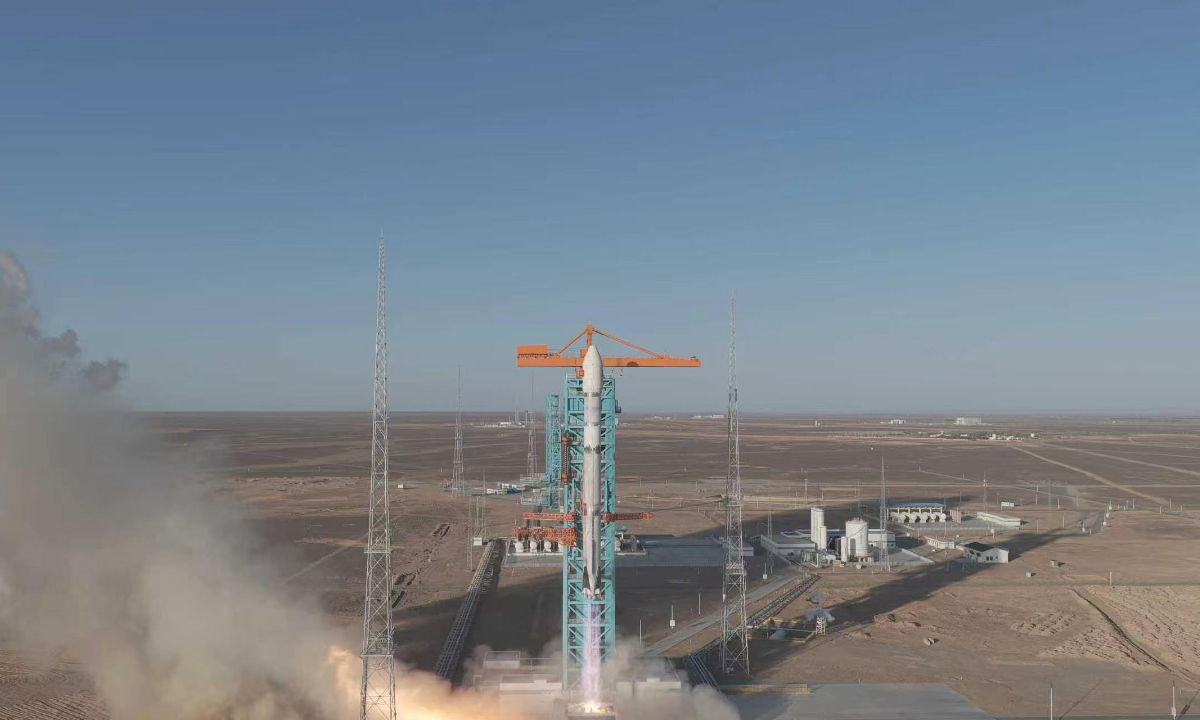
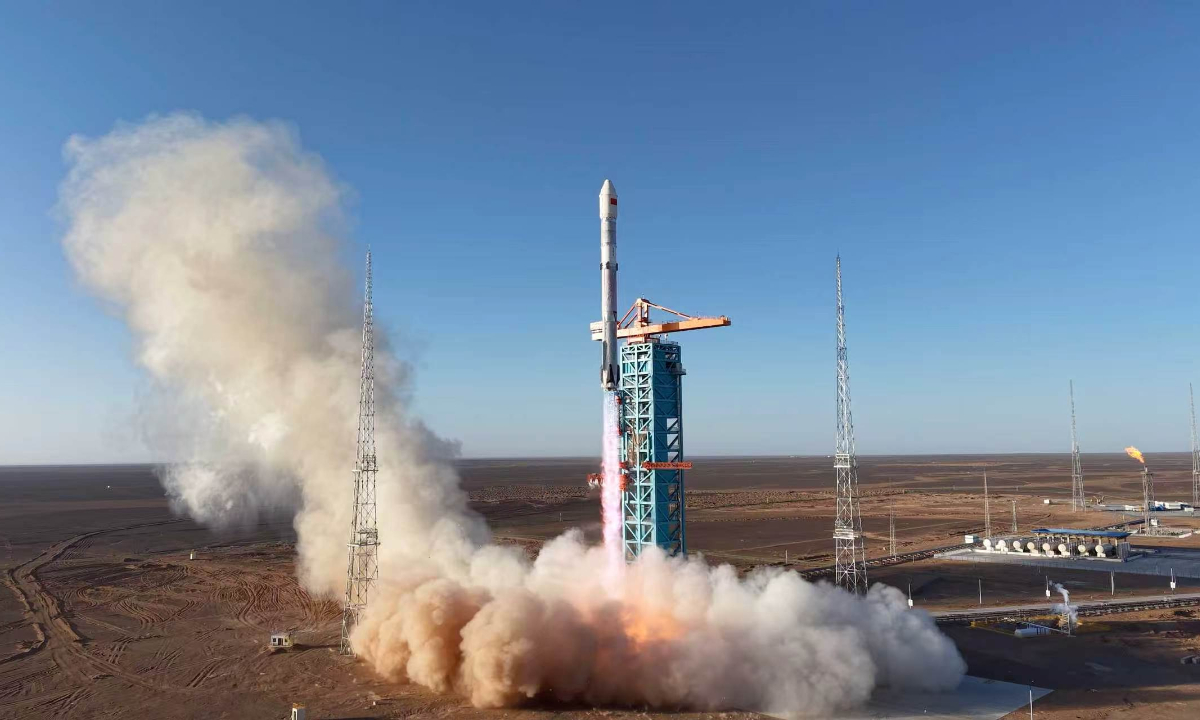
A rocket that once would have been discarded after completing its mission has now taken a different path - returning from the edge of space back to Earth. In the early hours on Wednesday, the Zhuque-3 Y2 reusable launch vehicle lifted off for a flight test, carrying not only a satellite payload but also a major test of China's emerging reusable rocket capabilities. After completing its orbital mission, the rocket's first stage attempted a controlled return and recovery, with its developers Beijing-based private firm LandSpace describing the mission as a key transition from technology verification toward engineering application for China's commercial aerospace industry. About 137 seconds after liftoff, the rocket’s first and second stages separated. The second stage continued its flight and successfully placed the Honghu-03 satellite, independently developed by Hongqing Technology, into its designated orbit. And at around 7:43 am, the rocket’s first stage successfully made a soft landing as planned at the Zhuque-3 landing site in Minqin county, Northwest China’s Gansu Province, marking the successful completion of the flight test mission. This mission marked China's first-ever recovery of a launch vehicle's first stage using landing legs, as well as the country's first land-based recovery of the first stage of an orbital-class launch vehicle, the developer highlighted. The achievement came shortly after China's Long March-10B reusable rocket successfully completed its maiden flight and a sea-based recovery test on July 10, marking a wave of breakthroughs in reusable launch technology. The parallel progress of state-owned and private aerospace players through different technical approaches is creating a dual-track development landscape for China's future low-cost and high-frequency space transportation, some aerospace experts told the Global Times.
Photos: Courtesy of LandspaceDesigned to fly again Unlike traditional expendable rockets, which are discarded after a single mission, reusable launch vehicles are designed around an entirely different concept: a rocket should not only complete a launch, but also return safely and be prepared for future missions. According to LandSpace, for conventional expendable liquid launch vehicles, the rocket itself represents the majority of launch costs, while fuel expenses generally account for only 1-3 percent. The first stage typically makes up about 70 percent of the total rocket cost. As a result, repeated reuse of rockets - particularly the first stage - can significantly lower launch costs by amortizing the cost of the vehicle over multiple missions. For partially reusable rockets that reuse the first stage while discarding the second stage, the cost advantage becomes increasingly evident as the number of reuse cycles grows. The Zhuque-3 is a reusable liquid oxygen-methane launch vehicle independently developed by Beijing-based private aerospace firm LandSpace for future large satellite constellation deployment missions, according to the company's statement. The rocket adopts a two-stage configuration, with a diameter of 4.5 meters, a total length of 66.1 meters and a liftoff mass of about 570 tons. Its first stage is equipped with nine Tianque-12A liquid oxygen-methane engines, as well as recovery systems including grid fins, attitude control systems and landing legs, enabling autonomous return and soft landing after orbital missions, LandSpace said. The Y2 mission was conducted on the basis of experience accumulated from the previous flight test, with improvements focused on recovery reliability, flight control and engine performance. LandSpace said it optimized the first-stage landing propulsion scheme by reducing the number of engines used during landing ignition, simplifying system design and improving reliability during the recovery phase. The company also added an autonomous safety control function capable of predicting landing points based on flight conditions and making corresponding safety adjustments. The mission also further verified key technologies including the use of stainless-steel rocket structures, liquid oxygen-methane propulsion and landing-leg recovery systems. According to LandSpace, stainless steel provides advantages in manufacturing cost, processing efficiency, high- and low-temperature performance and post-recovery maintenance, making it suitable for reusable rocket development.
Photos: Courtesy of LandspaceMore than a single rocket's return The significance of Zhuque-3 Y2 extends beyond one flight test, as it reflects China's broader effort to develop reusable launch systems through multiple technological routes, according to Chinese experts. Kang Guohua, a senior member of the Chinese Society of Astronautics and a professor of aerospace engineering at Nanjing University of Aeronautics and Astronautics, told the Global Times that China has become the second country after the US to develop orbital-class rocket recovery capabilities. The US currently leads reusable rocket development, with SpaceX and Blue Origin advancing different recovery technologies. China, meanwhile, has seen both state-owned aerospace programs and private companies explore different technical pathways, creating a diversified development pattern, Kang said. According to Kang, the parallel development of different approaches demonstrates the advantages of combining national strategic capabilities with market-driven innovation. Pang Zhihao, a prominent Chinese space exploration expert and retired researcher from the China Academy of Spacecraft Technology, told the Global Times that the successful recovery of Zhuque-3 would carry special significance for China's private aerospace sector. A landing-leg recovery approach would mean that private aerospace companies have completed the full process of developing a large-capacity reusable rocket system, validating key technologies including stainless-steel structures, multi-engine propulsion and recovery systems, Pang said. More to expect LandSpace said the first stage represents a significant share of the total cost of a liquid launch vehicle. Through repeated reuse, the cost of each launch can be gradually reduced, while production cycles can be shortened and launch frequency increased. Such capabilities are becoming increasingly important as countries and companies accelerate the deployment of large low Earth orbit satellite constellations, it added. The Zhuque-3 has demonstrated the ability to support various commercial missions, including satellite constellation deployment, single satellite launches and rideshare missions, according to LandSpace. The company said the rocket has achieved a maximum orbital payload capacity of 14.2 tons in expendable mode, while its reusable configuration is designed to support future constellation deployment needs. The Y2 mission also carried the Honghu-03 satellite developed by Hongqing Technology, combining reusable technology verification with a commercial launch application scenario. LandSpace said the mission verified the full chain of "design, manufacturing, testing, launch and recovery," laying the foundation for future commercial operations. The Zhuque-3 Y2 test comes as China's aerospace industry accelerates efforts to develop reusable launch vehicles. According to Chinese experts, multiple companies are now exploring different recovery technologies, including vertical landing and other innovative approaches, reflecting the rapid growth of China's commercial aerospace ecosystem. Reusable liquid launch vehicle, Pallas-1 will begin its mission from Galactic Energy's independently built facility at the Dongfeng Commercial Aerospace Innovation Test Zone in northwestern China, where the company will soon complete testing, propellant filling and launch preparation operations, according to its developer Galactic Energy on Thursday. Orienspace's Gravity-2 reusable large liquid launch vehicle is undergoing final ground testing ahead of its maiden flight, which is scheduled in the fourth quarter of 2026. The rocket is designed with a low Earth orbit payload capacity of 21.5 tons. Space Pioneer is advancing verification and joint testing of its Yuanxingzhe-1 (YXZ-1) rocket, while i-Space's Hyperbola-3 reusable rocket has completed full-cycle ground verification of offshore recovery and landing technologies and is expected to conduct its maiden flight around the end of 2026. Meanwhile, CAS Space's reusable Lihong-2 vehicle is being developed as a platform for verifying key recovery and reuse technologies, as well as conducting microgravity experiments. The vehicle is scheduled to complete its maiden flight and 100-kilometer-class recovery verification test in 2026. Pang said reusable rocket technology could help lower launch costs, increase mission frequency and provide stronger support for emerging sectors such as satellite internet, space-based information networks and future large-scale space applications. For China's private space sector, the Zhuque-3 Y2 mission represents a transition from technology verification toward engineering application, according to LandSpace. The company said it aims to further build a "launch-recovery-inspection-reuse" cycle to support future high-frequency and low-cost commercial operations. Experts said reusable rocket technology could help reduce launch costs, increase launch frequency and provide stronger support for emerging sectors such as satellite internet and large-scale space applications. The future challenge for China's reusable rocket developers will be turning successful flight tests into repeatable commercial operations, as the country advances toward a new era of high-frequency space transportation, they noted.




 (文章来源:券商中国)。