
舞动奇迹
China, Indonesia pledge deeper strategic synergy, firm support for each other's core interests at strategic dialogue_我的网站

A |
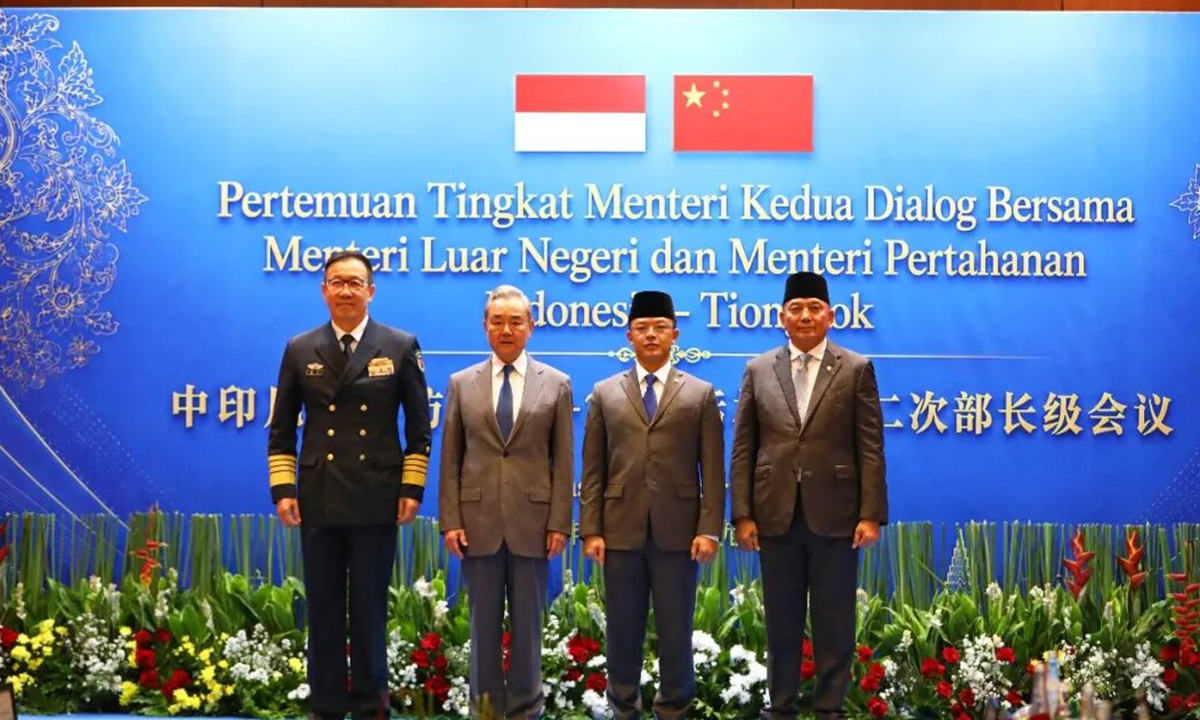
Chinese Foreign Minister Wang Yi and Indonesian Foreign Minister Sugiono co-chaired the conference. The two sides had an in-depth exchange of views on advancing the building of a China-Indonesia community with a shared future and reached broad consensus, according to Chinese Foreign Ministry's readout.
Wang said that the establishment of the comprehensive strategic dialogue mechanism is an important initiative for the two sides to implement the consensus reached by the two heads of state and advance the building of a China-Indonesia community with a shared future that enjoys regional and global influence.
Noting that China has always placed Indonesia in an important position in its diplomacy, particularly in neighborhood diplomacy, the Chinese top diplomat said China stands ready to work with Indonesia to strengthen all-round China-Indonesia cooperation, and pool greater development synergy to jointly tackle risks and challenges.
Stressing that the conference marks an important milestone in bilateral relations, Sugiono said China's development has brought enormous opportunities to the world, particularly neighboring countries such as Indonesia.
Sugiono added that Indonesia firmly adheres to the one-China policy and supports China's cause of reunification. Just in mid-August, the Chinese and Indonesian navies held a joint naval navigation exercise in waters east of China's Taiwan island.
The two sides also agreed to uphold strategic autonomy and firmly support each other's core interests. They also decided to launch the formulation of the China-Indonesia Five-year Action Plan (2027-2031).
The dialogue mechanism was established when Sugiono visited Beijing in April 2025.
Following the Conference of the China-Indonesia Comprehensive Strategic Dialogue Mechanism, the two sides also held a "2+2" meeting, pairing foreign and defense ministers in joint dialogue.
During the meeting between Chinese Defense Minister Dong Jun and his counterpart Sjafrie Sjamsoeddin on Friday, the two sides stated that under the strategic guidance of the heads of state of the two countries, the military-to-military relations face favorable development opportunities with broad prospects for cooperation.
Both sides should continue to strengthen military mutual trust, maintain close exchanges between the two militaries at all levels, deepen practical cooperation in multiple fields, and work together to safeguard regional peace and stability.
"Amid rising power politics, hegemonism, and protectionism, the first China-Indonesia Comprehensive Strategic Dialogue Mechanism conference has further enhanced strategic mutual trust and lifted bilateral relations to a new height," said Xu Liping, director of the Center for Southeast Asian Studies at the Chinese Academy of Social Sciences.
At its core, the mechanism does not target any third party; rather, it upholds win-win cooperation, peaceful development, and multilateralism while promoting collective self-strengthening of the Global South, said Xu. "It sets an example for the region and beyond, effectively offsetting extra-regional interference and noise from within and outside the region."
In specific areas, the two sides pledged to expand cooperation in areas such as artificial intelligence and poverty reduction. They agreed to restart cooperation in fishing, accelerate maritime cooperation and push forward joint development.
Both sides agreed that deepening cooperation in energy and mineral resources serves their common interests, and expressed readiness to jointly build a comprehensive, open and green partnership in energy and mineral resources.
Official data shows that China has been Indonesia's largest trading partner for 13 consecutive years, with bilateral trade reaching $167.49 billion in 2025, up 13.4 percent year-on-year. From the Jakarta-Bandung High-Speed Railway to industrial parks and other projects, the two sides have maintained a sound momentum of cooperation.
"As two important Global South countries with highly complementary economies, China and Indonesia have taken the lead in the region in integrating traditional sector cooperation with emerging economic cooperation," said Xu.
He added that Beijing-Jakarta cooperation is characterized by equal emphasis on and deep integration of traditional and new-quality productive forces. "Firmly grounded, multi-dimensional in scope, and rich in substance, it has become a bellwether for regional cooperation," Xu added.
In terms of the regional and global scope, the two sides also agreed to deepen cooperation within the framework of the four major global initiatives, strengthen policy coordination in multilateral mechanisms such as the United Nations and BRICS, oppose unilateral bullying and power politics, and safeguard international fairness and justice as well as the legitimate rights and interests of developing countries.
The two sides agreed to fully and effectively implement the Declaration on the Conduct of Parties in the South China Sea and work toward the early conclusion of the Code of Conduct (COC) in the South China Sea.
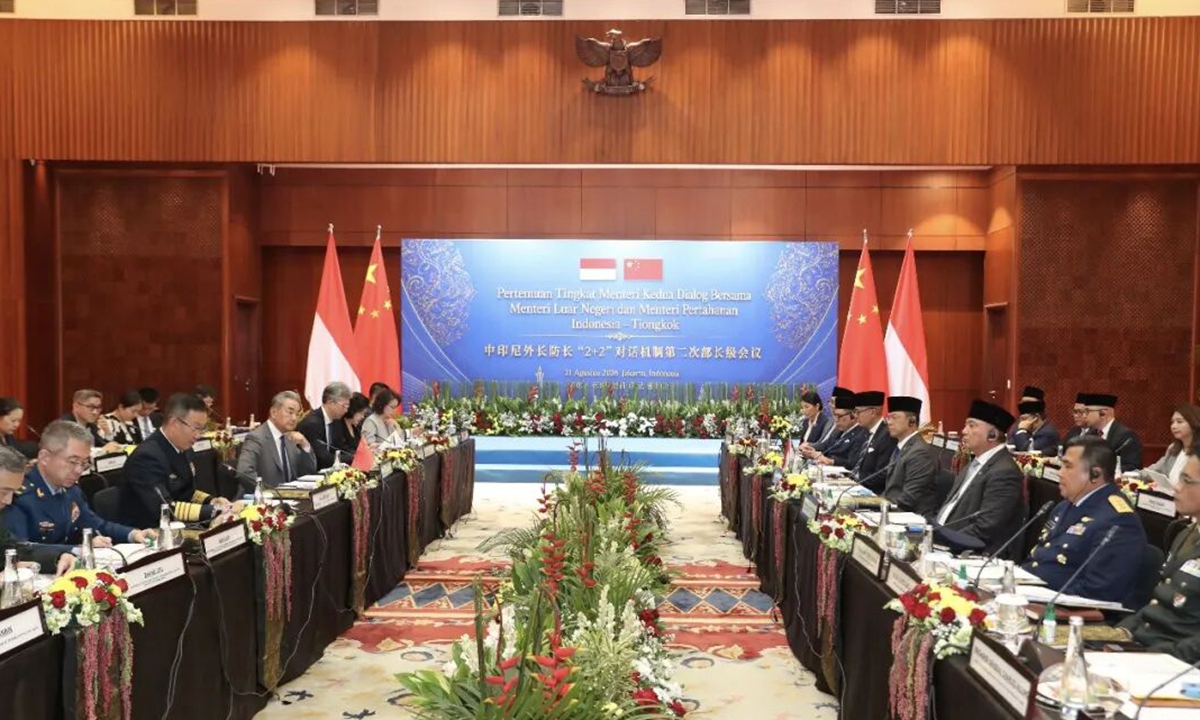
During the "2+2" meeting, the two sides agreed to deepen defense cooperation and promote the regularization and institutionalization of practical cooperation in areas including equipment and technology, joint exercises and training, personnel training, and maritime security, while continuously improving the quality and effectiveness of such cooperation, according to a readout released by the Chinese Foreign Ministry.
The two sides jointly advocate an Asian security model featuring shared security, and will work to uphold the mainstream of regional cooperation and peace and stability in the South China Sea, the readout said.
Amid attempts by certain countries to create trouble and fabricate confrontational false narratives in the South China Sea, China and Indonesia, both important South China Sea littoral states, are duty-bound to jointly safeguard regional peace and stability, said Xu. "Their consensus on this issue injects positive energy into the region, contributing to the early conclusion of the COC."
According to the expert, despite disputes, the overall situation in the South China Sea is manageable and stable, and the close cooperation between China and Indonesia demonstrates to the international community the broad trend and aspiration of peace, friendship, and cooperation in the region.
。
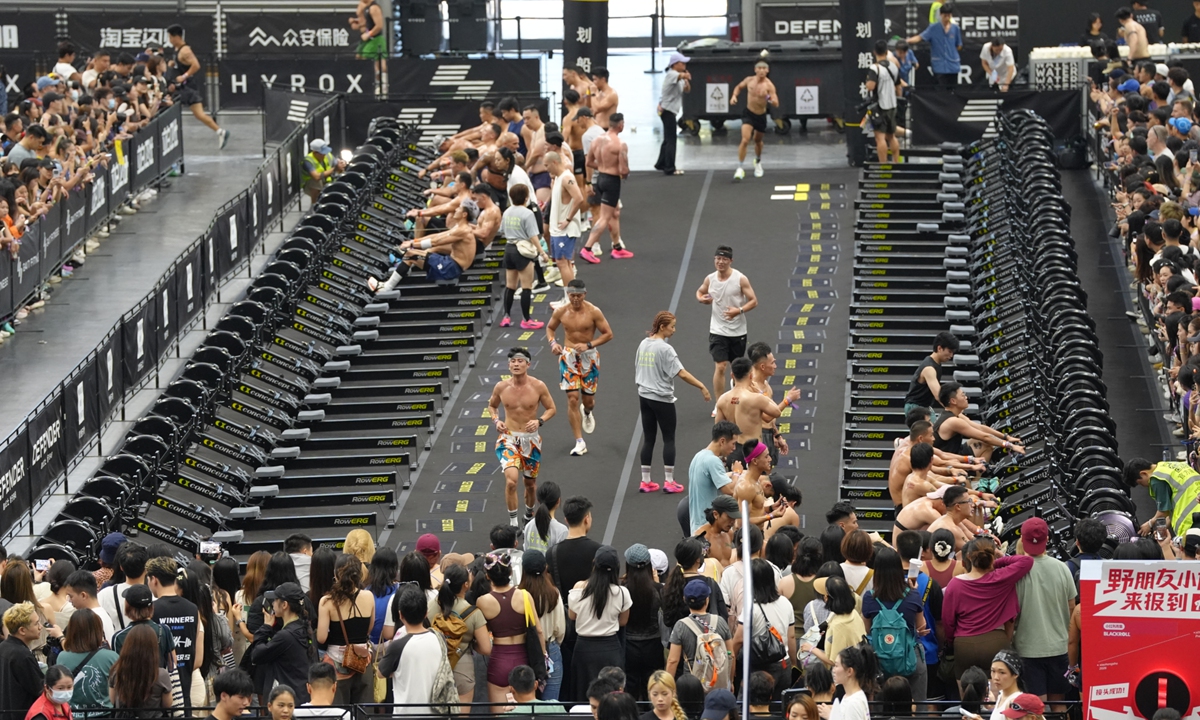
Over the weekend, participants from across China packed the Shenzhen World Exhibition and Convention Center for the German fitness race, according to HYRESULT, a platform that tracks Hyrox race results. The event was one of the Chinese stops of the 2026-27 Hyrox season.
Originating in Hamburg, Germany, in 2017, Hyrox was designed as a fitness competition for gym-goers. It combines eight 1-kilometer runs with eight functional workout stations, including sled pushes, indoor rowing, burpees, farmer's carries and wall balls.
Pronounced "high‑rocks", the brand has never formally disclosed where its name originates. Yet it is widely understood to be a portmanteau blending "hybrid" and "rockstar", a nod to the mix of endurance and raw strength demanded by its race format.
Hyrox has experienced remarkable growth in Europe and the US, with some events attracting over 50,000 athletes and 35,000 spectators. After entering the Chinese market in 2024, the sport has expanded rapidly, with more than 500 affiliated gyms now operating in the Chinese mainland, according to the Xinhua News Agency.
This rapid growth reflects Hyrox's appeal as something more than a workout. By combining standardized physical challenges with competition, measurable results and group training, the sport has turned fitness into a social experience for a growing number of young Chinese professionals.
A fitness enthusiast surnamed Zhang who competed in the Shenzhen race for the first time is one of them.
Before the event, he trained about five times a week, with sessions including sled pushes, indoor rowing and running. He also maintained a daily 5-kilometer running routine.
He entered the "open" category and finished in about 2 hours. For him, however, the result was only part of the experience.
"It is not only about seeing what I have achieved through fitness," he told the Global Times. "Seeing so many disciplined people training and competing together gives you a sense of belonging."
That sense of community is becoming a defining feature of Hyrox in China, where a growing number of young people in major cities are swapping the couch for the gym.
Guo Xin, a sports commentator in Beijing, told the Global Times, "In the past, many people went to the gym to lift weights or run, but their goals could be relatively vague. Hyrox gives them a clear challenge: finish the race and improve their time."
For people who may find it difficult to make new friends after entering the workforce, training together also offers a natural way to build new social circles.
That structure is particularly appealing to young people who want exercise to be both purposeful and social, Guo said.
Many participants train in groups, sharing workout plans, encouraging one another and meeting outside the gym.
According to Xinhua, Shanghai-based IT professional Zhang Lin, 27, said she initially signed up simply to join the fun. What kept her returning was her training group, where people from different professions trained together, talked about races and had meals on weekends.
The sport has also found a natural home on Chinese social media.
Training check-ins, race-day crowds, finish-line celebrations and photographs of exhausted competitors are easily turned into shareable content. The popular phrase "pay to suffer" has become something of a rallying cry among Hyrox participants, capturing the willingness of young people to spend money to put themselves through an intense physical challenge.
"The atmosphere of the competition, the ritual of crossing the finish line and hitting the gong, and training check-ins are all easy to share on social media," Guo said. "The process of working hard and then seeing the result is itself very infectious."
For many participants, the appeal is not necessarily about winning.
The global ranking system gives amateur athletes a way to see how their performances compare with others around the world, while still allowing them to focus on personal improvement.
The rapid expansion of Hyrox has also attracted attention from China's sports industry. But Wang Dazhao, a sports commentator, cautioned that even though Hyrox has successfully tapped into young people's demand for fitness and social connection, it is ultimately a commercial sports business.
Its long-term development in China remains to be seen, he said.
There are also safety considerations as the sport attracts newcomers. Although Hyrox promotes itself as a competition "for everybody," the races involve sustained high-intensity exercise and can place considerable demand on the cardiovascular system and muscles.
Pacing is key to competing in Hyrox. For recreational athletes who do not exercise regularly, pushing too hard from the start in pursuit of a fast time can carry significant risks. Elite athletes chasing records also face heightened risks as they push their physical limits.
Guo advised beginners to build a basic fitness foundation before chasing race times, gradually improving their running ability, core strength and lower-body strength.
Participants should also pay attention to warm-ups and recovery, particularly around the knees and lower back, and familiarize themselves with the proper form for exercises such as sled pushes and wall balls.
。

B |
Current article:http://www.minshixuanhabing.bond/list_3toggjw/f1cdv.docx
Published on:16:21:38
僵尸先生_Random reading
- 08-24Toaster Starring Rajkummar Rao And Sanya Malhotra Set For Mid-April Release
- 08-25Ranveer Singh Praises Virat Kohli After Stunning Century in First ODI
- 08-23Are Asian elephants losing their homes? The facts tell a different story
- 08-22Vivek Agnihotri And Bhushan Kumar Join Forces For A Film On Operation Sindoor
- 08-23雷军谈红米独立:释放小米手机的负担,冲向中高端
- 08-20三星注9韩文版开始推送官方版本的一个用户界面更新:基于Android 9派
- 08-23EconoScope | Why China remains central to global chains of industries despite tariffs
- 08-20贝尔的“空中出租车”出现在CES上。
- 08-20US Pentagon official’s Manila speech exposes alliance fragility, with Philippines likely to bear costs of provocations: Chinese expert
- 08-22Vaa Vaathiyaar Hit With Court Stay a Day Before Release

千金女佣_Active users
- 小鹿妈妈牙线,在看不见的地方下足了功夫
- Xi'an hosts ISU Junior Grand Prix opening leg
- 外星人的问候?加拿大发现了15亿光年的重复无线电波
- 【观点】国都期货:基本面偏宽松,豆粕或维持震荡走势
- Best Korean Movies on OTT: A Streaming Guide to The Finest Cinema From South Korea
- 名宿声明:FIFA现任管理层治下的足球运动正在背离其核心价值观
- Janhvi Kapoor Slams The Media for Insensitive Coverage of Sridevi and Dharmendra’s Demise
- Then Vs Now: Bollywood Child Artists Who Went On To Become Established Actors
- 【观点】南华期货:PP丙烯:短期方向不明,维持高位震荡
- 【仓单】8月26日大商所豆一期货仓单较上一日持平
- 2026年,中信建投期货公众号的优势有哪些?
- Palak Muchhal Reacts to Palash Muchhal and Smriti Mandhana's Wedding Debacle - Exclusive
- 伊森赛后回到球场加练罚球 火箭今日20罚仅11中
- 慢镜头:如果小基恩转会离队,佛罗伦萨考虑求购国米前锋博尼
- Salman Khan Meets Johnny Depp at Red Sea Film Festival, Sparking Amused Multiverse Reactions Online
- 9月13日期货夜盘螺纹、铁矿、沥青等品种走势分析_加仓_止损
- IIKBC表E412樱桃轴键盘新产品销售:619元,独立旋钮集成掌托
- 南非前世界拳击冠军家门口遭枪击身亡,已有4名嫌疑人被拘捕
晓说_Hottest this week
- 08-26“安装模拟器”将在测试后一个月底正式发布。将来,它将被添加到Nvidia RTX系列图形卡中。
- 08-24蒙太古杯-U16国足0-2墨西哥排名第四 仍创国少参加该赛事最佳成绩
- 08-25Missing Chinese student found dead in South Korea, murder suspect arrested
- 08-24AMD Radeon VII“三个燃气灶”将在CES:Alien Area-51上被携带
- 08-26Tight hug after 27 years: Reunion across ocean, marking China-US folk friendship
- 08-22华为驱散谣言:与袁隆平合作种植水稻的谣言
- 08-25Gen Z Russian teacher decodes China for his students using AI short drama
- 08-24【现货】8月26日各地区纯碱现货价格汇总
- 舞动奇迹 copyright
- Some of the content comes from the Internet. If you have any offence, please raise it.