
诈欺游戏
田代まさし氏、アクシデントで足骨折「妊娠している人とか子どもは絶対観ちゃだめ」映像公開へ_我的网站

A | 薬物依存からの回復を目指す元タレントの田代まさし氏(69)が24日までにYouTubeチャンネルを更新。
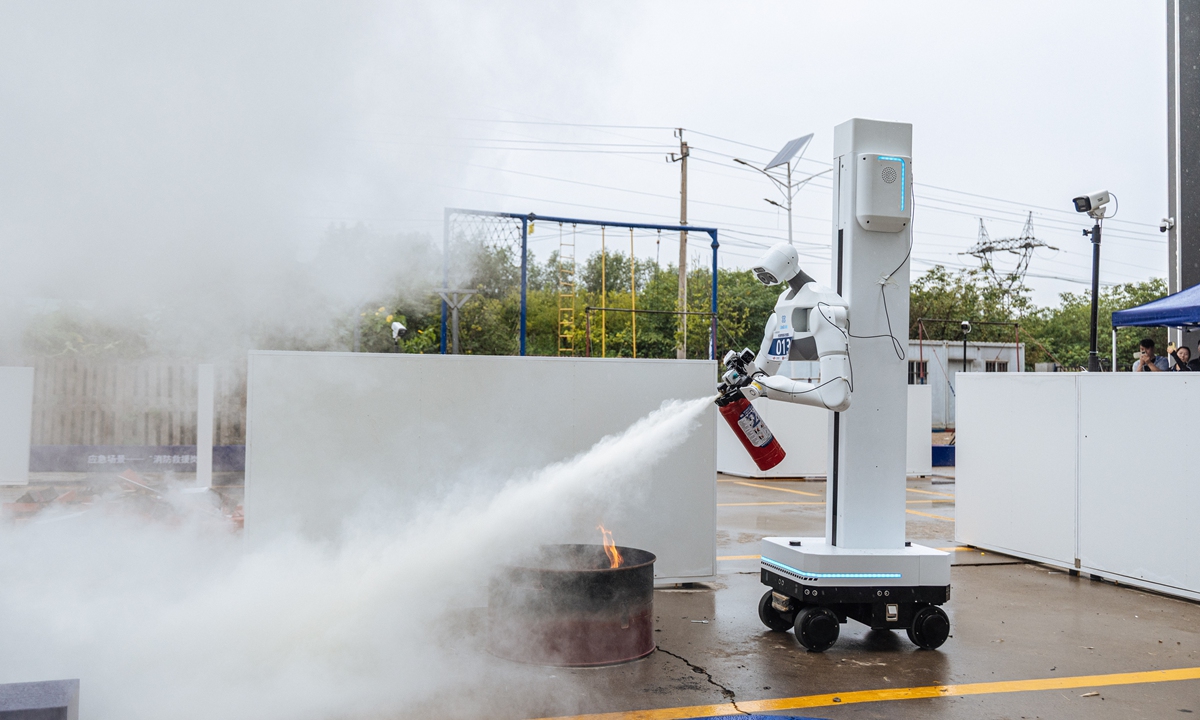
The firefighting final of the emergency management category at the 2nd World Humanoid Robot Games (WHRG) was held on Sunday in Beijing, putting 23 teams through a simulated rescue operation designed to test whether humanoid robots can move beyond demonstrations and perform practical tasks in complex real-world environments.
The event comes as Chinese humanoid robots, long known for eye-catching abilities such as running, dancing and music playing, are pushed toward practical applications, including jobs that are dangerous for humans such as emergency rescue.
Unlike the first edition of the WHRG last year, according to the organization committee, this year's scenario-based events emphasize "realistic simulation," with the firefighting competition being held at a fire brigade rather than in a model-room setup.
The competition simulated a firefighting assignment that required each of the 23 robots to complete three tasks within 30 minutes: identify hazardous materials, shut off valves and operate a fire extinguisher. For the first task, robots had to identify two randomly placed simulated hazardous substances and report their types to judges through returned images. They then had to locate three randomly selected open valves of different types and shut them off before identifying a fire source, finding a fire extinguisher and spraying it until the fire was put out.
Human firefighters were also involved in the event, lighting the fire and observing whether the robots carried out the extinguisher operation correctly.
The competition, however, showed how difficult it remains for robots to perform reliably outside controlled laboratory conditions.
Rain affected the competition, while changes in lighting and the outdoor environments added uncertainty to the robots' visual recognition and manipulation tasks. A team from UniX AI, a company well-known for its robot applications on real-world scenarios and has just raised a new round of 300 million yuan ($ 44.49 million) in late March, completed its run within the allotted time, but its robot moved relatively slowly compared to human firefighters' real practice. When operating the fire extinguisher, its robotic hand had to make two attempts to align with the target.
Of 12 teams competed on Sunday, three finished the challenge.
Yang Liqi, a representative of the UniX AI team, told the Global Times that the firefighting scenario placed higher demands on both the robot's recognition and manipulation capabilities.
"Rain and lighting conditions can affect the robot, and actual situations are often different from what we simulate in the laboratory," Yang said, noting that this was also one reason why a number of teams were unable to complete their runs on Sunday morning.
The team had programmed the robot to make up to three attempts when operating the extinguisher. "If it sees white smoke after the first attempt, it will not make a second attempt," Yang said.
The difficulty was not simply that whether the robot could move its arm. Humanoid robots rely on different types of joints for different tasks: small, high-precision joints enable delicate hand operations, while high-torque, reliable joints support movement and balance.
A failure at any point of actions and detection could affect the final result. This is precisely where the value of real-world competitions lies, Jin Chenran, a representative of the Tiangong team whose robot only accomplished one of the three tasks, told the Global Times.
"Whether the competition goes smoothly or not, that is the significance of a real-world simulation. Every real-world failure is valuable data that helps humanoid robots toward practical application," Jin said.
Jin further explained that questions like why the robot failed to recognize an object and how its motion-planning system selected the wrong path... Such data can subsequently be used to improve algorithms and train AI models.
The competition also offered a glimpse into the current transitional stage of humanoid robot technology. At the venue, some team members were wearing VR headsets and remotely adjusting their robots shortly before their runs.
Some humanoid robots were seen using omnidirectional wheels instead of feet, while their hands featured multiple joints to enable more precise manipulation. Many teams chose China-developed UBTECH's joint modules for their robots. Its servo actuators cover a wide torque range from 0.2Nm to 200Nm, allowing robots to combine dexterity with strength. Meanwhile, VR teleoperation gives operators a first-person view through the robot's cameras, enabling them to remotely guide movements in real time.
The event comes amid a broader push in China to move humanoid robots and embodied intelligence from laboratories and competition arenas into real production and daily-life environments. In June, the Ministry of Industry and Information Technology and the other departments launched a special program for humanoid robots and embodied intelligence that encouraged applications in practical fields including emergency rescue.
Zhao Weidong, deputy director of the organizing committee office, told the Global Times that the scenario-based competitions are intended to test the progress of humanoid robots from "competition performance" toward "real operational work," including whether they can eventually become intelligent partners for firefighters.
"At present, many simulations of actual operations may still be at an early stage," Zhao said. "But these are an important starting point for enabling robots to truly assist humans in real-world environments, as well as an important source of data and testing."
The ultimate goal, Zhao said, is to push robots into fields where human operations are dangerous and achieve genuine "human-robot complementarity."
。足を骨折したことを明かした。【写真】スノーモービルに乗る田代まさし氏 田代氏は恒例となっている自主的な薬物検査を行う中で、松葉づえを手に「これ見て分かる通り、足骨折してまして」と報告。

B | テロップで「ロケ現場に向かう途中でアクシデントがありマーシーが骨折する事態に!」と説明された。 その後、田代氏は骨折したアクシデントについて「ワカサギ釣りに行きまして。スノーモービルに乗って氷上に行くんですけど、その途中でスノーモービルがスピンいたしまして。投げ出されてものすごい硬い氷の湖面に打ちつけられて」と説明。「最初、筋肉痛かなと思ったんですけど、あまりに痛いんで病院行ったら、折れてますよって。薬物依存も回復途上、骨折も回復途中。全部が途中です」と話した。

C | なお、その際の映像もあるといい、近日公開予定とのこと。

D | 「妊娠している人とか子どもは絶対観ちゃだめ。衝撃だから」と笑顔で予告した。

E |
Current article:http://www.minshixuanhabing.bond/lcacy/cnvm.html
Published on:07:56:20
我的网站最近更新
- 存储行业太能赚钱了!佰维存储半年报出炉:一年前亏2.26亿、现在狂赚71.66亿
- 5月30日晚8点京东618超级补贴日重磅开启,补贴优惠力度前所未有,每人每天补贴超6180元!
- 琼海市疫情应急价格监测日报(2022年9月14日)_海南_防控
- MAMA Awards 2025 Day 1: ROSÉ and Bruno Mars' APT Wins Big With Major Category Sweep
- 特斯拉悄然上调美国市场两款 Cybertruck 车型售价,均涨价 5000 美元
- 支付宝宣布全球用户超过10亿
- 突传涨价!芯片巨头爆出大消息!影响多大?
- 台陆委会称其工作是“抵御中共统战” 国台办回应
- NYC to limit shelter stay for asylum-seekers with children
- 福州发布一批人事任免通知
- RTX 5080为何大受欢迎?网友很无奈:实在没得选!
- 车企忙着给自己请明星代言,对卖车真有用吗?
- 《Pokémon TCG》Delta Reign ETB 首度曝光,大家的评价出奇一致
- 618选NMN别盲目,这几个核心指标帮你避开抗衰智商税,锁定靠谱品牌
- 中使馆提醒中国公民切勿前往南基伍省等刚果(金)东部地区
- 微软 PowerToys 新增 Window Hopper:在 Win10/Win11 中可切换同一应用窗口
- 代码显示谷歌正在为 Google Play 商店应用开发 AI 图片搜索功能
- 国产哪吒新游官宣新试玩!全新pv将来 8.26科隆见
- Two police officers shot dead in Canada
- ‘풋살로 한·중 우애 쌓는다’…경기대 수원캠퍼스 K-PARK서 한·중 청소년 풋살 캠프 개최
- 耕地保护和质量提升法草案三审 进一步加大对黑土地保护力度
- 上市公司劝退应届生:离职or打螺丝 走只赔半月工资
- 苹果:同时播放homepod和iphone是个错误
- 眼红中法关系?这国外长却出手破坏,马克龙:我们需要中国
我的网站热门资讯
- Arijit Singh Brings Heart and Harmony to His New Romantic Single Fitratein
- 机场洗手液采购品牌推荐,维达商用保障枢纽公共卫生供给
- Illinois Shooting Suspect Charged With 7 Murder Counts, Faces Life Sentence - Attorney
- 天猫上线微信小程序天猫超市小铛家 要在微信内开展电商业务?
- 百花争艳!魔域口袋版花魁赛正式开启
- 优思益爆雷:与辉同行致歉并先行垫付全额退款,多位明星排队道歉
- 小米澎湃 HyperOS 4 Beta 版内测新增特别提示,部分第一阶段推送机型已开启第二批招募
- 地上波りくりゅう特集にチラッと映った人物に「うわ、懐かしい!」 引退から6年「すっかりイケオジに」
- 山西介绍煤化工跨区域质量强链项目成效
- 六股河口外海砂项目迈入规模化开采阶段
- Indonesia bans syrup medicines as children die
- IRS Backtracks, Edits Job Posting Seeking Agents Willing to 'Use Deadly Force' After Online Outrage
- 老後の年金、額面いくらなら「非課税」になる?ギリギリ課税世帯になると保険料負担はどうなる?
- 联发科首款 2nm 芯片:天玑 9600 Pro 芯片跑分曝光,GPU 与小米玄戒 O3 同源
- 7月中国核发绿证3.06亿个,7月中国核发绿证3.06亿个
- 本地上周通报187起骨痛热症病例 今年首次低于200起
- 路径有变!强台风“沙德尔”登陆浙江概率上升,温州、台州、丽水局地将有特大暴雨,杭州风雨最强时段集中在这天
- 山东一平房爆炸,周边多栋居民楼遭重创,知情人发声
- 沈白高铁辽宁段首铺
- 【阳光•活动】小年至,年味浓——沈北新区第三幼儿园
- 动力软件系统升级/优化能量管理 哈弗猛龙PHEV开启OTA升级
- 美国撤销联邦政府设备使用TikTok禁令
- Pak to demarche US envoy over Biden's statement on nukes: FM
- 网友质疑饲养员斥责大熊猫“萌兰”,北京动物园回应:饲养员手势是在沟通打扫区域,并非指向“萌兰”,望网友理性看待工作人员的日常工作