昨夜星辰
Philippine official fabricates ‘iron triangle’ narrative over Huangyan Dao; expert rebukes Manila’s smear attempt_我的网站

一 | 重大项目是高质量发展的“加速器”和“压舱石”。近日,国网新源辽宁清原抽水蓄能电站建设再次取得新进展,这也为6台机组全部投产发电的最后冲刺奠定了坚实基础。
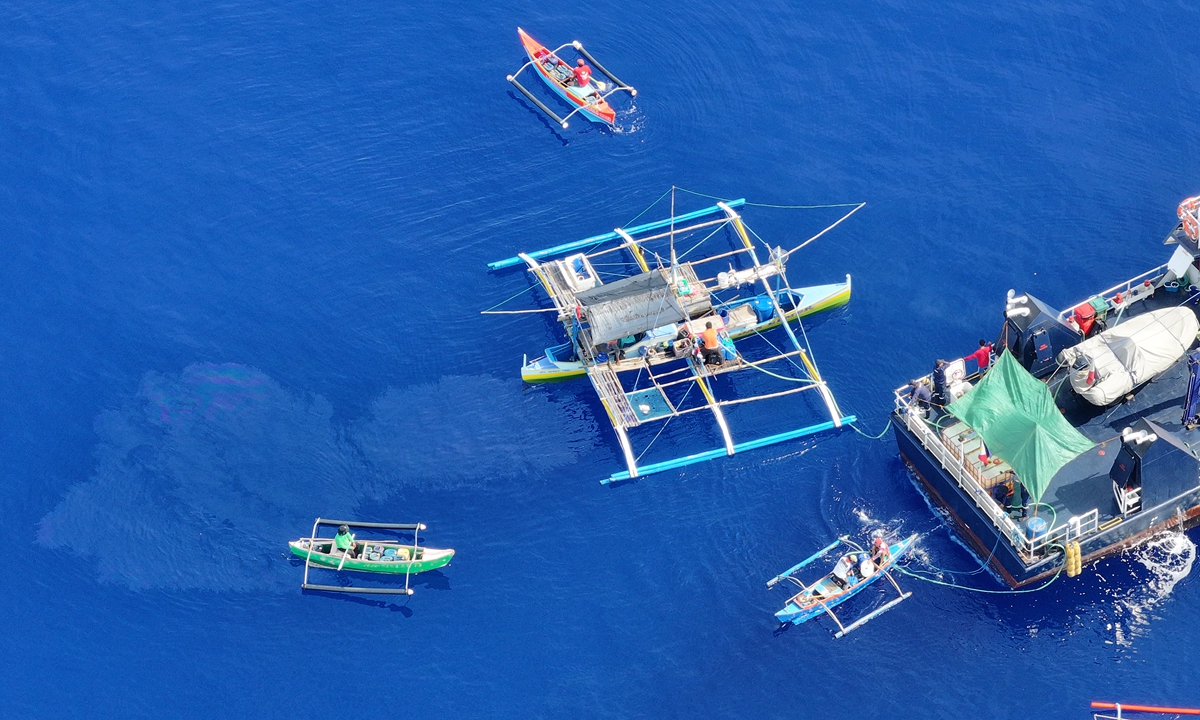
Drone image shows Philippine public vessels in waters near China's Huangyan Dao on July 23, 2026, for a supply mission for 12 Philippine "octopus boats" in the area. During the cargo transfer operation, a large amount of fuel supplied by the Philippine vessels leaked. Photo: Courtesy of China Coast GuardMarking another attempt to smear China's legitimate actions over Huangyan Dao, a Philippine Coast Guard (PCG) spokesperson claimed that China's possible "militarization" of the island could allow it to dominate much of the South China Sea and threaten freedom of navigation. Chinese experts said the claim deliberately hypes the so-called "China threat" rhetoric and turns the facts on their head, arguing that while Manila itself has been strengthening its military presence and fueling regional tensions, it appears to be demanding unrestricted access for its own vessels to waters around China's Huangyan Dao under the guise of "freedom of navigation."
PCG spokesperson Jay Tarriela claimed on Monday that Huangyan Dao is the last remaining point needed to complete China's "iron triangle" in the disputed waters, according to Manila Bulletin.
Tarriela claimed during the National Maritime Council's (NMC) first semester press briefing in Manila that if connecting the Xisha Islands with Huangyan Dao, and Huangyan Dao with the Nansha Qundao, "it will allow China to dominate the entire maritime space of the South China Sea." He claimed that such pattern threatens freedom of navigation in a route carrying a large share of global trade.
In a social media post, Tarriela went further, alleging that if China "militarizes it (Huangyan Dao), the triangle closes and the danger stops being a Philippine problem."
China has never carried out any so-called "militarization" of Huangyan Dao. The latest claim is another victimhood narrative fabricated by certain people in the Philippines to portray the country as being threatened and rally other countries behind its position as freedom of navigation has been a closely watched topic internationally, Chen Xiangmiao, director of the World Navy Research Center at the National Institute for South China Sea Studies, told the Global Times, noting that China's activities around Huangyan Dao mainly involve routine patrols and law enforcement actions by the China Coast Guard to safeguard national sovereignty, security and maritime rights and interests.
China exercises sovereignty and jurisdiction over relevant waters in accordance with law. Even the deployment of law-enforcement forces or necessary defensive capabilities in relevant areas by no means freedom of navigation in the South China Sea would be affected, said Chen.
He argued that the South China Sea remains one of the world's busiest international shipping routes, and normal commercial navigation has never been obstructed by China. What the Philippines calls "freedom of navigation" appears to conflate commercial navigation with its demand that Philippine fishing vessels, coast guard ships, government vessels and even warships be allowed unrestricted access to waters around China's Huangyan Dao.
Last month, the Philippine side organized seven public vessels, three coast guard ships and one fish transport ship, and egged on a large number of fishing boats to illegally assemble in the waters under China's jurisdiction at Huangyan Dao, Jiang Lue, spokesperson for the China Coast Guard (CCG) said.
During this period, three Philippine public vessels - MMOV 3001, MMOV 3005 and MMOV 3017 - ignored repeated dissuasion and warnings from the CCG and obstinately intruded into the territorial waters of China's Huangyan Dao, Jiang added.
The CCG took necessary countermeasures in accordance with the law against the Philippine rights-violation vessels, including verbal warnings, blocking, and shooting water cannons, to resolutely expel them.
The Global Times learned that the Philippines harbored clear provocative intentions in this aggressive intrusion. Its vessel MMOV 3001 repeatedly charged at high speed into the 12-nautical-mile territorial waters surrounding China's Huangyan Dao. On-site footage obtained by the Global Times also shows this Philippine vessel was fitted with anti-collision padding, prepped for anticipated vessel collisions.
Also last month, Chinese foreign ministry firmly rejected and said it will never accept the delimitation of the so-called "baselines of the territorial sea" of China's territory of Huangyan Dao by the Philippines, stressing it is illegal, null and void.
The statement came after the Philippines claimed it has deposited its official nautical chart of Huangyan Dao and its surrounding maritime zones with the United Nations Secretariat.
With regard to the Philippines' illegal and false claims, China's Ministry of Foreign Affairs said in the Friday's statement that Huangyan Dao is China's inherent territory. China has indisputable sovereignty over it and its adjacent waters, and has sovereign rights and jurisdiction over the relevant waters. China has continuously, peacefully and effectively exercised sovereignty and jurisdiction over Huangyan Dao. The territory of the Philippines has been defined by a series of international treaties, and Huangyan Dao has never been a part of it. The Philippines' illegal territorial claim over China's Huangyan Dao is completely baseless under international law, according to the ministry.
Chen said that in fact, it is increasingly clear who is fueling militarization in the South China Sea. The Philippines has continued to strengthen their military presence and activities in the region in recent years. Manila's attempt to smear China's legitimate actions around Huangyan Dao as a threat to freedom of navigation is essentially a political narrative rather than a reflection of the actual state of navigation in the South China Sea.
。

二 | 眼下已进入决胜全年目标任务的关键阶段,辽宁清原抽水蓄能电站正以昂扬的奋斗姿态,借山水之势,囤蓄电能,立足资源禀赋,全力打造发展新质生产力的绿电优势。
日前,记者来到清原抽水蓄能电站,偌大的地下厂房内,灯火通明,六台发电机组沿着厂房中心线依次排列,工程技术人员正在对5号机组的运行参数进行日常巡检。11月30日19时,电站5号机组顺利实现投产发电。
国网新源辽宁清原抽水蓄能电站运行部值班员敖思达说:“ 目前,5号机组各项运行数据稳定,截至12月10日,5号机组严格参照电网调度指令,有序开展启停53次,累计发电3245万千瓦时。”
辽宁清原抽水蓄能电站开工8年多来,建设者们克服地质复杂、地下洞室群庞大、施工难度大、危险多等重重困难,追星逐月推进工程建设,现如今,工程建设进入到收尾阶段。电站建设的顺利推进得益于省、市、县级政府的大力支持,市发改委与省发改委紧密配合,开拓创新,抢时快办,2016年10月28日核准批复清原抽水蓄能电站,2016年12月8日,清原抽水蓄能电站宣布开工兴建,创出令大型水电建设项目艳羡的“清原速度”。
在电站建设中,建设者们遇到了一个棘手的难题。由于清原抽水蓄能电站所处地区冬季最低气温可达零下37摄氏度,水库冰层可能对大坝、闸门等水工建筑和电站设备造成破坏,影响机组正常运行。

三 | 工程人员充分调研抽水蓄能电站设备防冰冻情况,联合参建单位在电站建设期间开展多次试验,最终采用气泡防冰技术,利用压缩空气,在水下形成扰动水体的气泡群,从而阻止水面形成冰层。

四 | 该项技术的成功应用,为寒冷地区抽水蓄能电站水库冬季防冰盖封闭提供了解决方案。

五 |
国网新源辽宁清原抽水蓄能电站运行部值长秦健说:“ 年底收官战的冲锋号角已经吹响,电站已全面进入“冲刺状态”。目前,我们正在对6号机组进行整组调试。以试运行指挥部为中心,下设启动调试组、验收检查组、生产维护组和综合组,不舍昼夜地加快机组安装、调试步伐,力争早日实现6台机组全面投产发电。”
辽宁清原抽水蓄能电站6台机组全部投产发电后,每年可减少标准煤耗15.8万吨,减少二氧化碳排放约37.5万吨,年缴纳税金超一亿元,将对推动能源绿色低碳转型、构建新型电力系统和加快发展新质生产力发挥重要作用。也将成为推动抚顺、清原经济社会发展的强大引擎,并有效助力辽宁清洁能源强省建设。

六 |
责任编辑:刘春阳。
Current article:http://www.minshixuanhabing.bond/65h/f12.doc
Published on:00:43:27
